Today is my birthday. I’m 34. To celebrate, I’m writing an essay to unpack “Self-Esteem” — laying out my understanding of this term built up over 34 years. When I wrote the title, I deliberately chose “robustness” over “stability.” In engineering, robustness implies fault tolerance and resilience — it asks whether a system can keep running even under extreme conditions. Stability, on the other hand, usually refers to whether a system remains steady under normal operating conditions. When fragile self-esteem takes a hit in real life, that’s hardly a normal operating condition.
The one who used “stability” to describe self-esteem is psychologist Michael Kernis. He decomposed self-esteem into two dimensions — “level of self-esteem” and “stability of self-esteem” — and mapped them onto four quadrants. Among the two high-level quadrants, he called high-level, high-stability self-esteem “Optimal Self-Esteem,” and high-level, low-stability self-esteem “Fragile Self-Esteem” — the kind that’s confident on the surface but hypersensitive, easily wounded by criticism. In casual Chinese conversation, you’ll often hear things like “this kid has a lot of self-respect” or “so-and-so has high self-respect, really cares about face.” The “self-respect” in these expressions refers to Ego, not Self-Esteem. And when we say someone’s “Self-Esteem is genuinely high,” we mean their “level” of self-esteem is high. But what exactly does this “level” refer to?
This brings us to another psychologist, far more famous in the field of self-esteem: Nathaniel Branden. He identified two core pillars of self-esteem (The Two Pillars): Self-Efficacy and Self-Respect. Only when both pillars are high is the level of self-esteem high. His bestselling book is The Six Pillars of Self-Esteem.
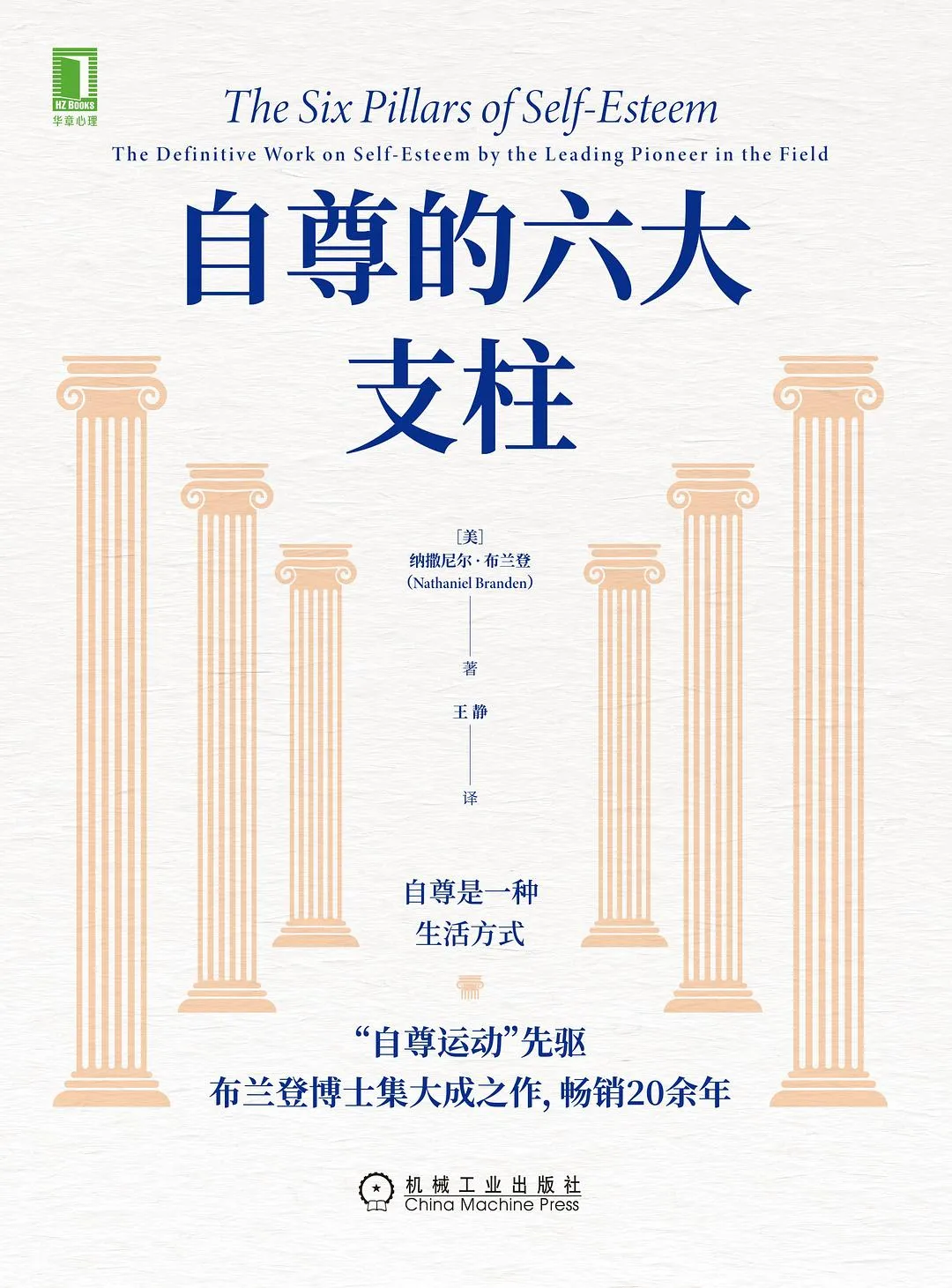
He really loved the word “pillars” — The Two Pillars, The Six Pillars.
In my view, The Six Pillars are the process (the practice) of cultivating self-esteem. These six practices include: Living Consciously, Self-Acceptance, Self-Responsibility, Self-Assertiveness, Living Purposely, and Personal Integrity. Notice that doing well in these six areas elevates both self-efficacy and one’s sense of worthiness. Self-esteem, then, is not a static “quantity you possess,” let alone some “base stat” you’re born with. It’s dynamic — a stability system maintained through constant interaction with reality. That is, we can cultivate our self-esteem by living consciously, by practicing self-acceptance, by taking self-responsibility, by being self-assertive, by living with purpose, and by aligning our values with our actions.
The Two Pillars of Self-Efficacy and Self-Respect, on the other hand, represent the state (level) of self-esteem. Self-Efficacy is a sense of competence — confidence in one’s ability to meet life’s basic challenges. Self-Respect, I’d equate with “worthiness” — the sense that I am worthy, that I deserve, whether it’s emotional connection, happiness, success, or the right to enjoy the fruits of one’s labor, and even “existence” itself. It’s the “existence” that Sartre (Jean-Paul Sartre) spoke of in “Existence Precedes Essence.” We already exist — of course we deserve to exist — before we try to prove who we are, before I try to prove how remarkable I am.
Forgetting who you are — it’s like the Buddhist concept of non-self (Anatta). Since we already exist in this world, whether to satisfy curiosity or to fulfill our duties and obligations, we should throw ourselves into doing things, collide more with reality. Discard notions of being “above” or “below” anyone. Approach problems pragmatically, considering only Effectiveness. The concept of effectiveness comes from Dialectical Behavior Therapy (DBT) — letting go of obsessions about “fairness,” “deserving,” or “whether others respect me,” and asking only about effectiveness: “What action would be most effective right now, in this specific situation, to achieve my goal?”
I’m reminded of Duan Yongping’s two-part formulation: “Do the right things” and “Do things right” — yet he never said anything about “being a good person” or “being the right kind of person.” He stripped away the Ego part of himself quite thoroughly. He’s fact-oriented, respects logic, patterns, and causality, and pours his energy into “observing” and “adjusting.” As I mentioned earlier, self-esteem is a system — rationally, we can use cybernetics to guide how we navigate life. Under cybernetics, there is no final verdict of success or failure — only continuous dynamic adjustment.
In that famous Steve Jobs interview, he explained that the reason he was so blunt, even harsh, with employees was that he believed for people who genuinely pursue excellence (A-Players), “doing things right” matters far more than “protecting their self-esteem.” The work (the product) is not “an extension of the self,” and criticism of the work is not an attack on the creator.

This brings to mind another book: Steven Pressfield’s The War of Art, where the method for weakening inner resistance is to turn professional (Turning Pro).
Part of turning pro involves this same idea of “maintaining detachment from your work.” Beyond that, Turning Pro also means showing up consistently and enduring monotony. “Enduring monotony” has something in common with “doing things right” — it echoes all those motivational sayings about “success requiring massive repetition.” We need to find a monotonous action. Combine this with David Allen’s GTD and James Clear’s Atomic Habits, and this action should be measurable and low-pressure.
Layer on top of that the concept of non-self, and you get this string of modifiers — a self-disregarding, monotonous, measurable, low-pressure effective action.
In the film The Final Master (师父), the Wing Chun grandmaster Chen Shi has a line: “Since age 15, I’ve swung my blade 500 times a day. I use this number as my discipline.” Swinging the blade is that effective action — monotonous, measurable, low-pressure. Five hundred swings a day, not letting stray thoughts disturb the mind. What are stray thoughts? They’re ideas about self-definition that arise from interacting with reality. What is the mind? The mind is “self-esteem” — an undisturbed mind is exactly what we’ve been calling “the robustness of self-esteem.”
You might wonder: in the concept of non-self, is the “self” that’s being negated the “Self” or the “Ego”? And what’s the relationship between Ego and Self-Esteem? When people say casually “he takes himself too seriously,” the “himself” refers to Ego. The “self-respect” in the colloquial expressions I mentioned at the beginning — the ones that point in the opposite direction of “Self-Esteem” — that’s also Ego. In my view, an enormous Ego is precisely a compensatory defense born from impoverished self-esteem. When someone pays excessive attention to their Ego, inferiority and arrogance will appear as two sides of the same coin within the same person. The classic example is the smart kid in school — (I’m talking about myself, by the way) — who first assumes a self-image of being clever, but then fears failing the exam, so doesn’t dare go all out in preparation. Then when the results come back, the first thing they say is “I didn’t even try,” using that to console themselves and protect their fragile self-esteem.
Let me introduce two opposing concepts of Self here. Whether it’s Alice Miller’s Authentic Self vs. False Self, or Shaun Gallagher’s Functional Self vs. Narrative Self, or Karen Horney’s The Real Self vs. The Idealized Self — in my view, by definition, the former in each pair is more objective, the true self; the latter is more subjective, a self processed by the mind. In this essay, Ego can be reduced to Subjective Self minus Objective Self — the gap between the idealized self and the real self. Returning to the smart kid example: he has a Subjective Self with high standards and demanding expectations, but he’s afraid that after the exam he’ll confront that Objective Self. Unable to face the gap between the two, unable to face failure, lacking the courage to accept the test of reality, he resorts to “I didn’t even try” to offset his “self-esteem depletion” — and wastes his academic potential.
The fourth point of Turning Pro in The War of Art is precisely “disregarding self-esteem depletion.” In Heinz Kohut’s Self Psychology, this “depletion of self-esteem” is called “Narcissistic Injury” — when real feedback shatters the mirror, The Idealized Self collapses and crumbles, exposing The Real Self: helpless, fragile, seemingly underdeveloped, even shameful. In the context of this essay, both “self-esteem depletion” and “Narcissistic Injury” can be reduced to facing the gap between the two Selves. The fourth point of Turning Pro — “disregard self-esteem depletion” — means “disregard the gap between the two,” which means “disregard Ego,” which means “non-self.”
Elon Musk has many quotable lines about Ego. The one that stuck with me most is: Many people fail because the ratio of ego to ability exceeds sine 1. Why did it leave such an impression? Because he overshot the flex — “exceeds 1” would have been perfectly sufficient to make his point, but he just had to go with sine 1, hahaha. This so-called “flexing” is exactly the act of inflating one’s Subjective Self. Musk, in a single sentence describing Ego-less-ness, managed to put his own Ego on full display. He still cares about what people think of him. He still needs to maintain his geek persona — which is why he’d come out with something so pretentious and logically incoherent.
Since he likes formulas, his original intent can be understood as this equation:
I’m not entirely satisfied with the Ability part. I prefer the term “potential,” and Ability should be Potential with the Ego component stripped away.
As discussed earlier, replacing the success-or-failure binary with a cybernetic perspective means changing the left side of the equation from Success to Result. On the right side, in addition to ability, there should also be Direction as a vector (corresponding to “doing the right things”), Execution, and Probability. So the equation becomes:
Rearrange the order and we find:
When the ratio between the two selves combines with execution, that’s exactly the self-disregarding effective action I mentioned earlier.
So often, the harder we try to grasp at something, the less result we get. It’s only when we let go of our so-called obsessions that we can execute effective actions and truly Turn Pro — and then, almost perversely, life actually gives you a shot at results. Take my key insight from years of marathon training: be honest about your real ability. When my actual capability was a three-hour finish, my Subjective Self insisted on seeing itself as a 2:40 runner. So even though I was grinding hard in training (Execution was high), because I was forcing myself to train at 2:40 marathon pace, I’d be doing anaerobic work when I should’ve been training lactate threshold, and lactate threshold work when I should’ve been building aerobic base. The actual effect was diminished by this misalignment — it even led to deteriorating form and mounting anxiety, potentially going negative from injuries. As the saying goes, “more haste, less speed.” But when we continuously test reality, bravely face the Objective Self, bring the Subjective Self closer to the Objective Self, and repeatedly execute effective actions — our efficiency improves, our results get better, and self-esteem gains robustness.