Race Results
At 10:00 AM on March 22, the 2026 Wuxi Marathon came to an end. My net finish time: 2 hours, 54 minutes, and 24 seconds. My net placement happened to be exactly 2,222nd. Average pace: 4’08”. The split times recorded by the official timing mats are shown in the table below. If you do the math, the pace through 25 km was exactly 4:00/km, and from 25 km onward it was 4’20”/km.
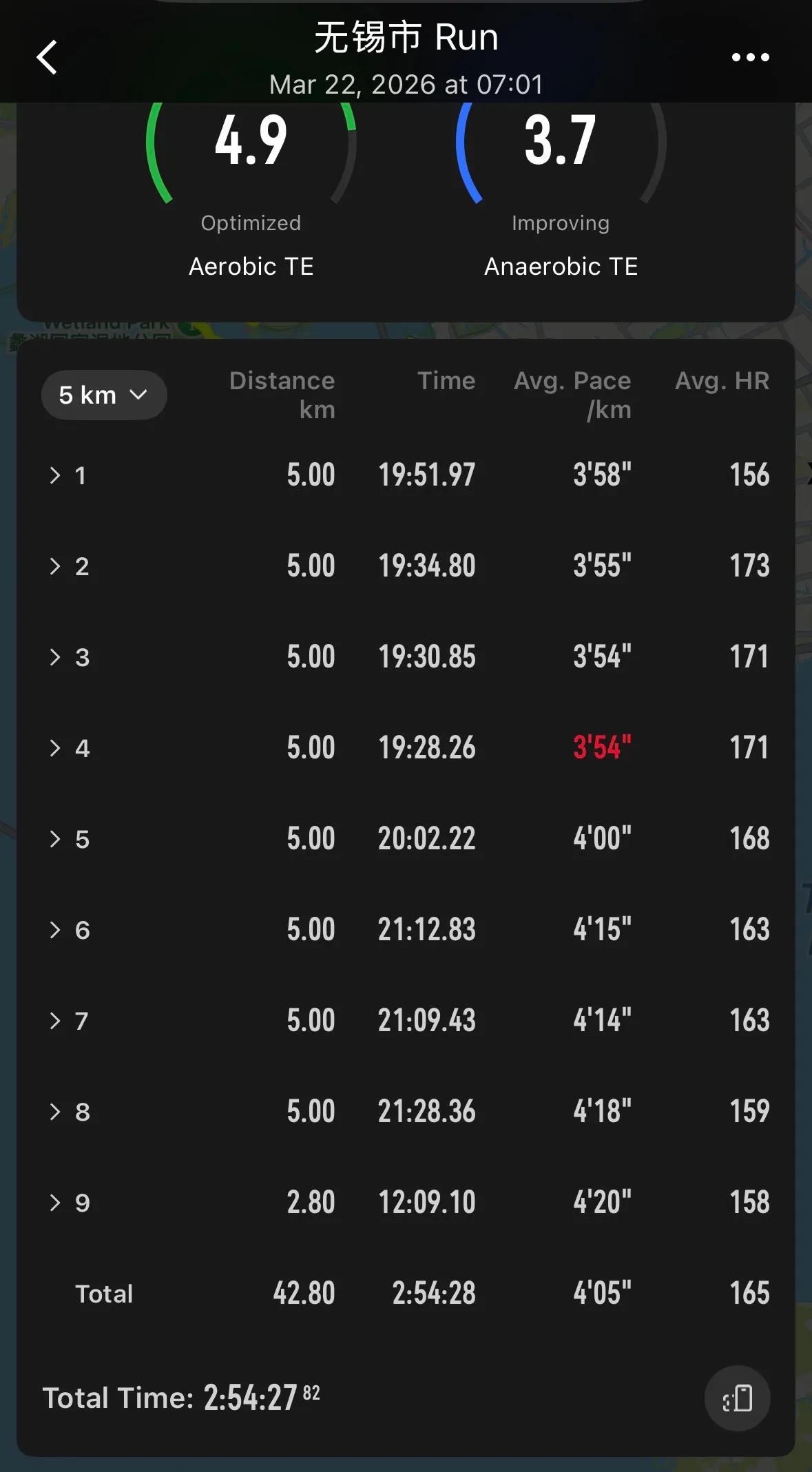
But my watch told a different story. It recorded the total race distance at 42.8 km, with a first-half pace as fast as 3’53”. Wuxi Marathon has a lot of turns, and the course is quite wide. Grabbing water at aid stations means taking detours, which all adds extra distance.
Still, that 3’53” first-half pace was actually right on my target. How did I trust myself to hit that pace? Let me start from winter training.
Training Philosophy and Micro-Cycles
In December 2025, I ran the Fuzhou Marathon and finished in 2:58. My training throughout 2025 wasn’t great — my average monthly mileage was only around 200 km, with a lot of physical energy siphoned off by my work as a Les Mills instructor. At Fuzhou, I experienced that crushing pressure in my chest again. I genuinely wondered: is my marathon peak stuck at 2:50? But in the later stages of that race, the more frustrated I felt, the faster I ran — my last 10 km averaged under 4:00/km. Coming into 2026, against the odds I actually got into Wuxi Marathon via the lottery. Carrying that sense of unfinished business, I decided to prepare seriously.
My training followed two principles: 1. Hit 500 km in monthly mileage. 2. Do a lactate threshold intensity session every four days.
Working backward from the ultimate goal of a 15 km tempo run right at LT2, I broke it into interval sessions: first twelve 1 km repeats, then transitioning to six 2 km repeats, four 3 km repeats, two 6 km repeats, until I could complete the final big workout.
In each four-day micro-cycle, day one was for this intensity session, and the remaining three days were for absorbing the work and building aerobic base. I had trained exactly this way during the winter of early 2025 when I ran 2:50 in Chongqing, so I knew this approach worked. Besides, at Chongqing Marathon I hadn’t rested well, and I’d run an all-out half marathon just one week before the race. So I figured if I could build a more solid aerobic base this time and get back to my early-2025 lactate threshold fitness, I could absolutely go under 2:45.
The timeline was tight, though. The race was on March 22, minus three weeks of taper, leaving only January and February — two months of real training. When choosing a target race, I had gone back and forth between Wuxi on March 22 and Baoding on April 19. After Chinese New Year, with only four weeks left, I decided to just go for it at Wuxi. So on top of the lactate threshold sessions, I started adding marathon-specific big workouts. In the four-day rotation: day one for lactate threshold, day three for marathon-specific work (drawing heavily from Renato Canova’s Specific Endurance sessions), and days two and four for recovery runs only. After the second cycle of this, my heart sent another warning. The evening I blew up on a specific workout, I was sitting still watching TV when I suddenly felt a tightness in my chest, a heaviness that made me afraid to breathe deeply. This persisted for four consecutive days. I dropped all running entirely.
I think the combined intensity of the threshold sessions and the specific workouts was just too much — my body simply couldn’t recover. Even if my leg muscles could bounce back, my heart muscle and central nervous system couldn’t. I kept thinking I could fast-track my way to the goal. But more isn’t always better. Sometimes it’s worse.
My January and February mileage did hit the 500 km target, but by the time I was confident my heart had recovered and the pain at rest had disappeared, only three weeks remained before the race. I decided to go straight into the pre-race taper. Eight days before the race, on March 12, I ran a 10 km race to substitute for the originally planned 15 km LT2 tempo run — the ultimate session. I finished in 37:52, averaging 3’47”/km. Through 4 km I was averaging under 3’40”, but then the chest pain came back and I was forced to slow down. Barely. Just barely. That result would have to serve as a barely adequate conclusion to the winter’s intensity block.
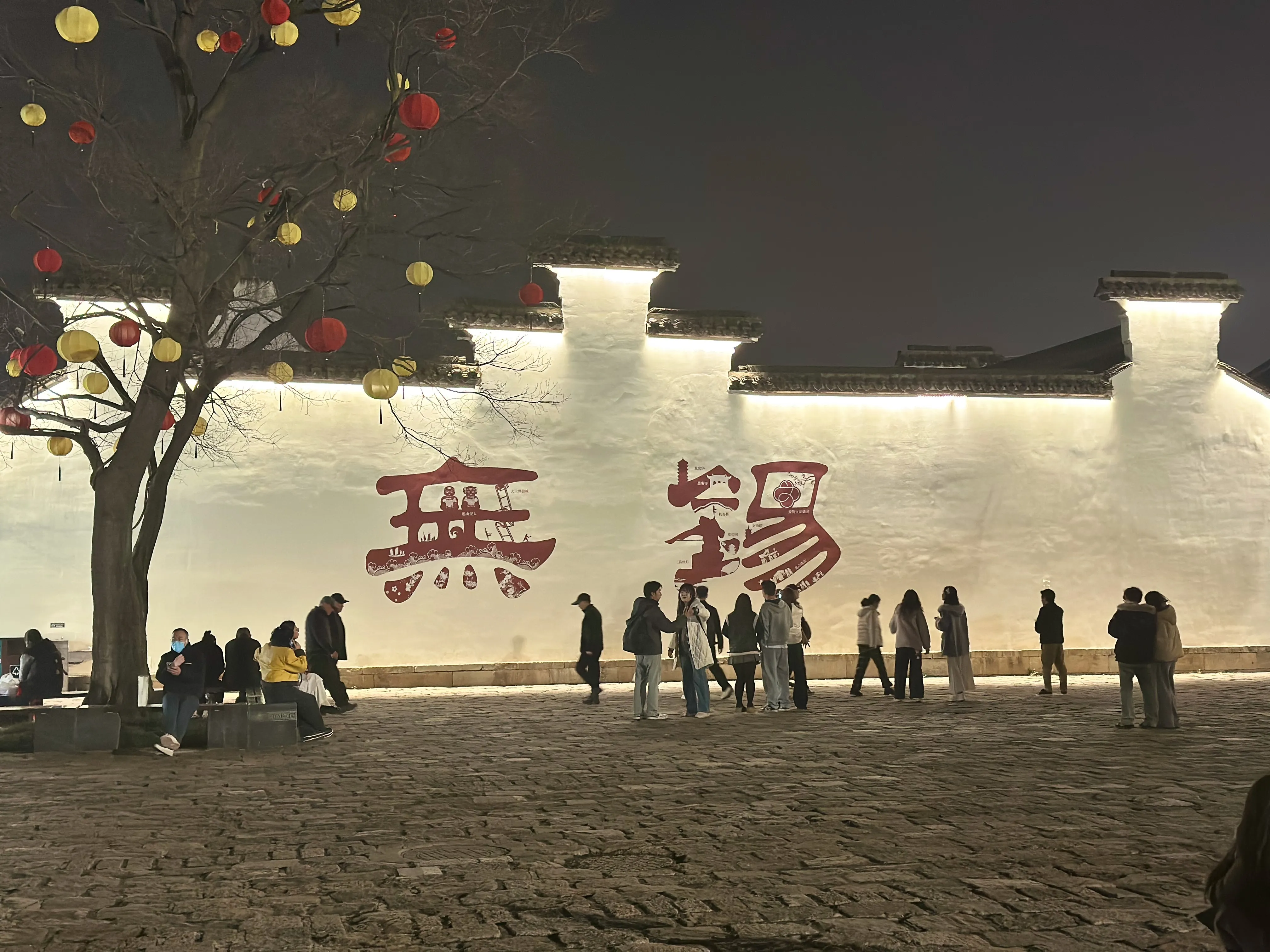
On March 18, bright and early, we boarded the high-speed train to Wuxi. Two days of sightseeing, cherry blossoms, and soaking in the arrival of spring in the south.
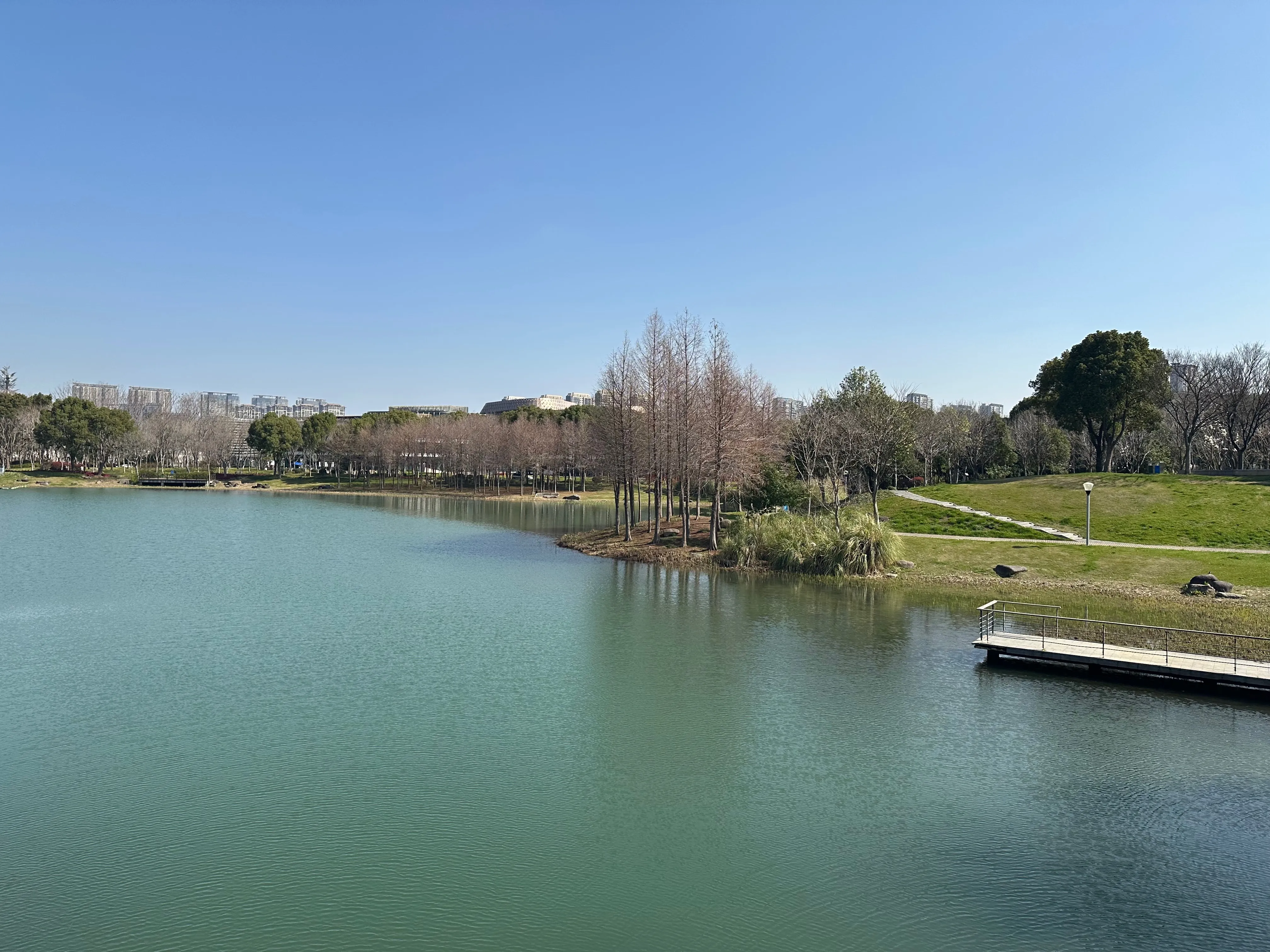
The public infrastructure in the Jiangsu-Zhejiang-Shanghai region is truly impressive. The parks are grand and beautiful, inheriting the elegance of classical Chinese gardens — purple rubber running tracks, lush green lawns, sculptures, vendors, pavilions — with refined design sensibilities visible everywhere. These parks aren’t just great for running; their sheer number and scale are staggering. The marathon course passes through a massive chain of parks starting from the Civic Center around km 24 and stretching south all the way to km 41. Under the guise of a spring outing, my girlfriend and I scouted the route in advance where she’d hand me private aid.
Race Day Details
This was my third time running Wuxi Marathon. The first was in 2021 — my debut marathon, starting in Corral F, weaving and dodging through the crowd the entire way, finishing in 3:25. In 2024, already a sub-three runner, I started in Corral B and set a new PB of 2:56. This year I’d moved up to Corral A+, yet somehow after the gun went off I still couldn’t find open space — there were so many people. The further up you are in the seeding corrals, the calmer the runners. Everyone was holding back, keeping the pace controlled. You couldn’t hear anyone breathing hard. Everyone was composed, starting squarely in the aerobic zone. Not wanting to waste energy unnecessarily, I went with the flow — nasal breathing, mouth exhaling — and the effort felt great. I wasn’t looking at my watch, just treating it as a pure aerobic run. Passing Lihu Lake, the humidity rose and my glasses fogged up. Then my chest tightened again. Fortunately it wasn’t severe — just a faint sensation that passed after a while.
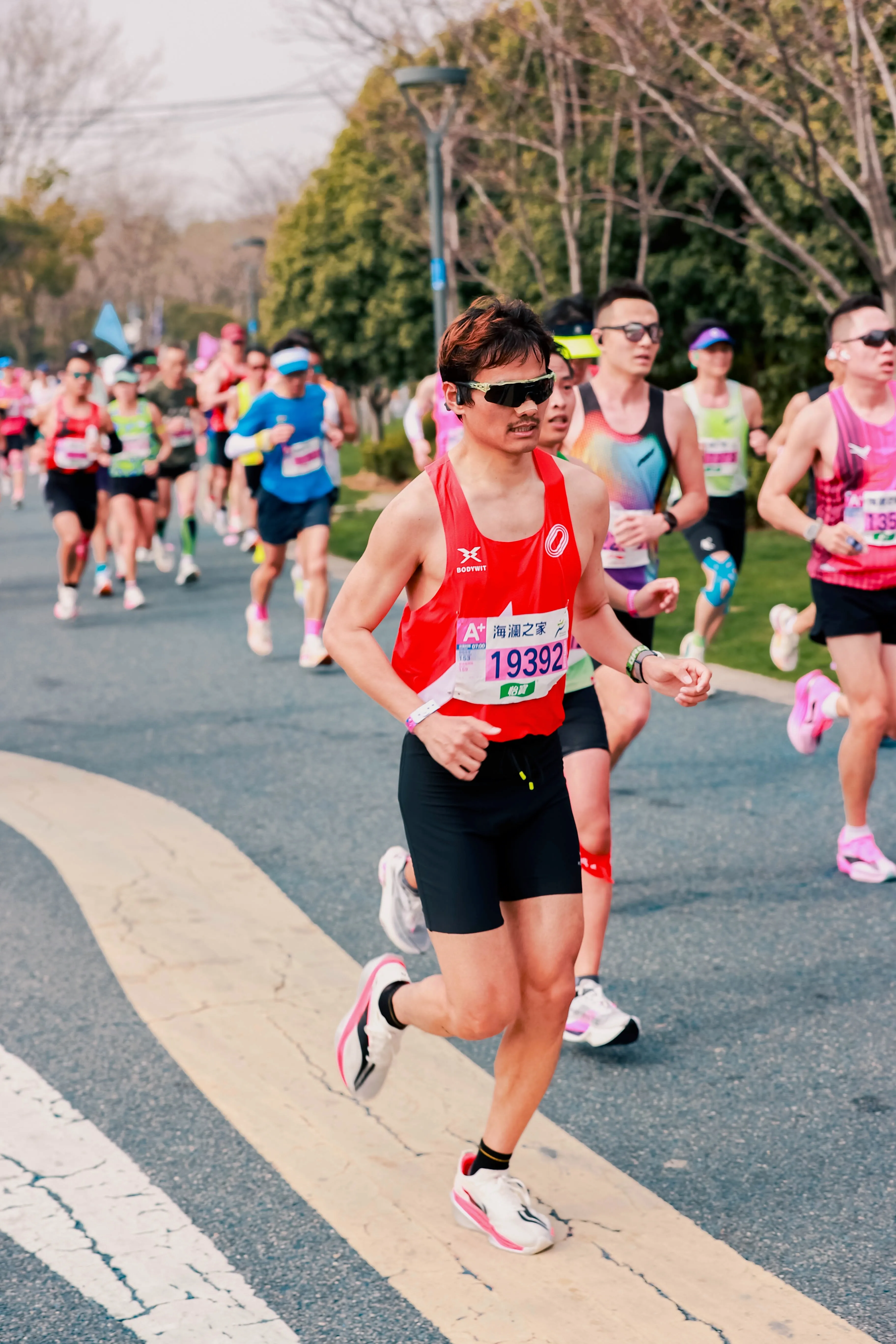
Looking at my watch data after the race, even though the first half felt aerobic, my heart rate had already climbed to the upper limit of the lactate threshold zone (170 bpm). Had I seen that data in the moment, I can’t say whether my final result would have been better or worse — seeing numbers that far off would have really messed with my head. It wasn’t until we exited Yuantouzhu and turned left toward Jiangnan University that the road widened again, and I finally started to find some space.
Past the halfway mark, I needed a bathroom. To this day I still can’t figure out whether it was cold-induced diuresis or pure nerves. Ever since the Hengshui Lake Marathon in fall 2023, I’ve been running to the bathroom non-stop before every race. This time was no different. At least Wuxi Marathon had plenty of portable toilets near the start. Starting thirty minutes before the gun, right up until five minutes before, I alternated between warm-up shuttle runs and bathroom visits — five trips, and I produced something every time. But then the national anthem started playing. I rushed through my last bathroom break, squeezed into the A+ corral, and by the time the gun went off, I needed to go again. I held it through the start. The first half wasn’t too bad, but by km 27 I couldn’t hold it anymore. Fortunately there was a portable toilet at the aid station.
So there I was — sweating from running, hitting every aid station for water, stopping to pee, and getting so dehydrated my head started pounding. I honestly don’t know what’s wrong with my body. Hot races: I sweat too much and fall apart. Cold races: my extremities freeze and I can’t stop peeing. Why doesn’t anyone else seem to have this problem?
At km 31 I spotted my girlfriend. Happy moment. She handed me a gel and water, we exchanged some cheerful words, talked a bit of trash. Then I kept running and completely fell apart.
By the time we entered Gonghu Bay, all fighting spirit was gone. At the turnaround I saw Li Meizhen leading the women’s race, but I couldn’t even muster a shout of encouragement. I just held my form and ground my way to the finish. No surge of emotion. No familiar faces in the crowd — everyone had gotten so much faster. The training partners who used to run my pace years ago, I’d either bump into them during races or at the finish line. But in recent years I’ve kept my head down and kept running, scaling back on socializing. The people I trained with back then have either quit the sport entirely or gotten much faster. Only I remain, standing guard at the gates of three hours, watching the crowds come and go, struck by a peculiar melancholy — like mourning someone who’s already gone.
Post-Race Reflection and Summer Training Plans
Since the start of 2026, I had quit smoking. By the time of Wuxi Marathon, over 80 days without a single puff. After the race, that evening I went to a dinner gathering that left me deeply uncomfortable, and I got upset. I’m not sure whether the central nervous system depletion from running a full marathon played a role, but I wasn’t happy with how I handled myself at dinner. And I was even less happy with myself for relapsing into smoking afterward due to weakened willpower.
I smoked again for three days after getting back — less than two packs. I could feel the large particulate gunk building up again, clogging the coronary arteries of my heart. Headaches, nausea, chest tightness. So I quit again.
And in my view, there’s something self-destructive about running a marathon. Every time you go all-out in a marathon, you inflict countless micro-tears in your muscles. After a marathon, you repair your muscles, repair your nerves, and by the time you can run again, you find your fitness has dropped. Your whole muscular system feels scattered — your squat 1RM can drop by as much as thirty percent. It’s like entering a sand sculpture competition at the beach: working furiously, paying attention to every detail, patiently sculpting, day and night, tense and focused. The judges come over, score your work, and then kick it to pieces.
Everything starts from scratch. Build strength, stack aerobic volume, develop VO2max, raise the lactate threshold, convert to race-specific fitness — all the way until the next race where you go all-out again, and then your body gets kicked to pieces one more time.
On April 12, the Beijing Half Marathon. On April 19, the Baoding Marathon. I’ll run both, not chasing results — just jogging. In April I’ll rebuild my base, let my heart heal, avoid burning out the body. Slow, steady progress from a stable foundation.
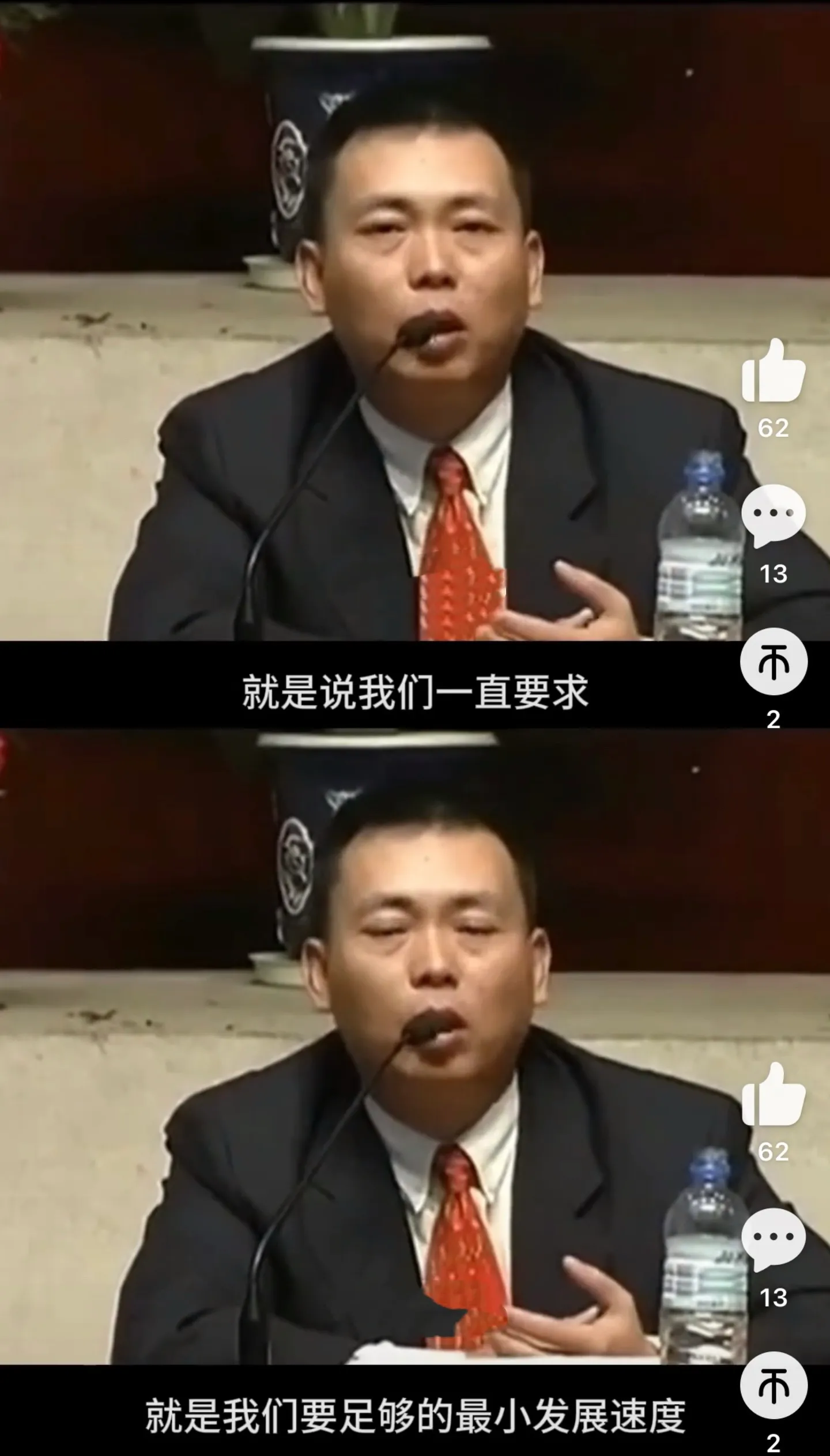
There’s a principle in endurance training called the “minimum effective dose” — and it mirrors what Duan Yongping calls “sufficient minimum development speed” when talking about running a company. At marathon finish lines (at least those held in mainland China), spectators cluster only in the final 200 meters before the finish. Everyone loves watching the sprint to the line. Nobody notices the long, monotonous, yet steadily controlled 42 km of cruising that came before it. Less worship of “dark horses” and “explosive growth.” Narcissism is the obstacle.
As long as the company stays alive and the product stays competitive, time is your friend — the goal will eventually be reached.
As long as you don’t get injured, don’t burn out on running, maintain your mileage, and train scientifically, age becomes an advantage — and the PRs will keep coming.